Blockchain, Big Data, IoT, AI, and Cloud Storage for Improved Transparency, Safety, and Decision Making

Blockchain, Big Data, IoT, AI, and Cloud Storage for Improved Transparency, Safety, and Decision Making
Our global agriculture supply chain, from the farm to our plates, is a complex labyrinth of processes. While it enables the movement of food across vast distances, this complexity also introduces challenges regarding transparency, food safety, and efficient decision-making. However, the advent of technologies like blockchain, big data analytics, Internet of Things (IoT), artificial intelligence (AI), and cloud storage can help overcome these hurdles, leading to a more resilient, efficient, and trustworthy food system.
The Agriculture Supply Chain: Understanding the Intricacies
The agri-food journey encompasses multiple stages: cultivation, harvesting, processing, packaging, transportation, retail, and consumption. Ensuring transparency and food safety throughout this intricate network is crucial yet challenging. However, with the proper application of modern technologies, these challenges can be tackled effectively.
Blockchain: A Leap Towards Transparency and Food Safety
Blockchain technology stands as a robust solution to address issues related to traceability in the agricultural supply chain. The blockchain is a decentralized, tamper-proof ledger that records each transaction as an immutable block linked chronologically, thereby providing a reliable audit trail.
Blockchain’s inherent traceability ensures the verification of food origins and promotes food safety. It can substantiate claims about a product’s origin, process, and handling, thereby preventing food fraud and building consumer trust. Moreover, smart contracts within the blockchain can automate transactions, improving supply chain efficiency and reducing scope for errors.
Big Data Analytics: Enabling Informed Decisions
In the agricultural domain, data is everywhere – from soil conditions and weather patterns to crop yields and market trends. Big data analytics can convert this massive, complex data into actionable insights, promoting informed decision-making.
Using big data analytics, farmers can make data-driven decisions such as optimal planting times, appropriate crop varieties based on climate and demand, and efficient resource utilization. Simultaneously, it can identify bottlenecks and inefficiencies in the supply chain, thus enhancing operations and food safety.
IoT: Reinforcing Real-time Monitoring and Decision-making
The Internet of Things (IoT) is a network of interconnected devices that communicate and exchange data. In the agri-food supply chain, IoT devices like sensors, RFID tags, and GPS trackers can offer real-time data on various parameters like location, temperature, humidity, and more.
IoT can empower precision farming, enabling real-time monitoring of soil and crop health, and informed decision-making. Furthermore, it ensures that storage and transport conditions are within safe limits, thereby maintaining food quality and safety.
AI: Streamlining Operations and Predictive Decision-making
Artificial intelligence (AI) can revolutionize the agricultural supply chain through automation and predictive decision-making. By analyzing vast datasets, AI can identify patterns, make predictions, and automate tasks.
AI can help predict crop yield based on factors like weather and soil conditions, aiding farmers in better planning. In the broader supply chain, AI can aid in demand forecasting, inventory management, and optimal routing in logistics, ensuring food reaches consumers in the freshest state.
Cloud Storage: Unifying Data for Enhanced Transparency and Decision-making
Cloud storage is pivotal in managing the colossal amount of data generated across the agricultural supply chain. It allows secure and easy data sharing among stakeholders, fostering transparency and collaboration.
Cloud platforms can also host blockchain networks, big data analytics tools, AI models, and IoT device management. This integration creates a comprehensive digital ecosystem, promoting transparency, efficiency, and informed decision-making in the agricultural supply chain.
Integration: The Way Forward for a Safer, Transparent, and Decisive Food System
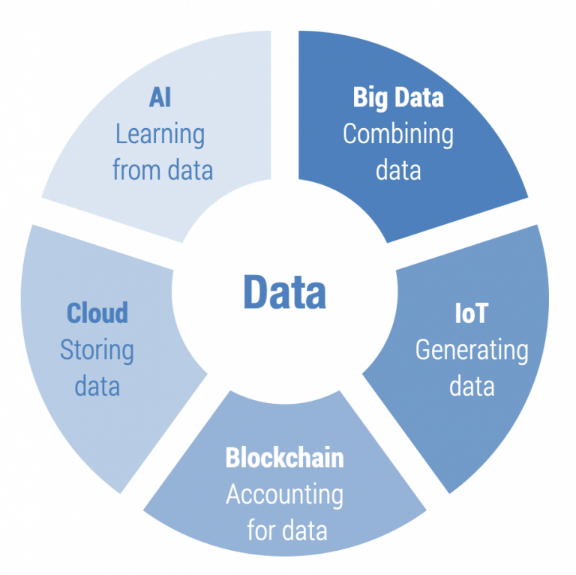
While each of these technologies offers significant benefits individually, their combined potential is truly transformative. Imagine a scenario where IoT devices collect real-time data, stored in cloud platforms, analyzed by big data analytics and AI for actionable insights, and each action recorded on the blockchain for traceability.This integration would create a highly transparent, safe, and responsive food system, optimizing decision-making at each step.
Conclusion
As we navigate the complex challenges of a growing global population, changing climate, and increasing food demand, the integration of blockchain, big data analytics, IoT, AI, and cloud storage presents a promising pathway. These technologies can significantly enhance transparency, improve food safety, and promote efficient decision-making in the agricultural supply chain. This is not just a step towards advancing agriculture, but a leap towards a safer, more transparent, and decisive food future.
About dFarm
dFarm is a leader in supply chain optimization for the agriculture sector. By collecting more data from each operation in the supply chain dFarm offers unparalleled transparency and visibility into supply chain dynamics. We use emerging technologies like blockchain, big data analytics, IoT, and AI to better collect, store, analyze and interpret the vast data sets we collect, enabling us to deliver superior business intelligence that can advance smarter decision-making.