Executive Summary
Chittoor is one of India’s most important mango-processing regions, but Totapuri farmers remain exposed to seasonal oversupply, weak price discovery and immediate-sale pressure. At the same time, processing companies face heavy seasonal working-capital requirements, inconsistent raw-material quality, regulatory compliance obligations and delayed recovery of funds from pulp sales. Conventional procurement therefore creates financial stress for both farmers and processors.
dFarm developed a producer-led alternative: farmers supply mangoes for conversion into aseptic pulp, retain the economic interest in the finished inventory, store the product under professional custody, access financing against eligible warehouse stock, and liquidate through organized domestic and export markets. AIMS™ provides the shared digital control layer for registration, batch traceability, quality records, inventory, authorization, financing coordination and settlement.
Core achievement
The initiative has progressed beyond an idea into a multi-stakeholder implementation framework. dFarm coordinated with State and Central Government authorities and played a crucial role in advancing regulatory recognition of mango pulp as a commodity for warehouse-receipt financing, while developing the CWC–processor–dFarm operating model needed for implementation.
Changing the Market Perception
Before dFarm’s intervention, the prevailing perception was that India was overproducing both table and processing mango varieties, that mango-pulp exports had limited demand, and that continued low prices left farmers with little choice but to remove mango trees. This narrative treated the problem as excess production rather than a failure of consumption development, value addition, market access and value-chain coordination.
| Prevailing perception | dFarm’s evidence-based perspective |
|---|---|
| India produces too many mangoes. | India’s annual per-capita fresh mango consumption is only about 1.5 kg, indicating substantial room to grow domestic consumption and organized retail access. |
| Mango pulp has inadequate demand. | Per-capita mango-pulp consumption in India is only about 125 grams, showing significant potential for beverages, food products, retail packs and institutional use. |
| Exports cannot absorb additional pulp. | The global processed-mango market is growing at approximately 7% CAGR, creating opportunities for quality-consistent, compliant and traceable Indian products. |
| Farmers must remove trees to correct supply. | The deeper need is to improve quality, processing efficiency, financing, product development, domestic consumption and global market access — not simply reduce productive orchards. |
dFarm therefore reframed the mango challenge: India does not merely have a production problem; it has a value-chain, consumption-development and market-access opportunity. AIMS™ helps convert production strength into traceable supply, value-added products, finance-ready inventory and organized domestic and global sales.
From Research to Industry Mobilization
dFarm conducted detailed value-chain research to identify the gaps between farmers’ selling prices, processing costs, wholesale prices, and consumer purchase prices. The analysis showed that substantial value is created across the chain, but it is not distributed efficiently among farmers, processors, and other value-chain partners.
Based on these findings, dFarm identified significant potential for the mango industry to become financially sustainable with limited direct government support, provided that transparent pricing, efficient processing, warehouse financing, market development, and appropriate enabling policies are established.
dFarm therefore engaged farmers, farmer associations, processors, regulatory authorities, government departments, and financial institutions to develop and implement an industry-survival and growth model. These stakeholders have supported the framework through operational participation, regulatory coordination, policy development, financing, and domestic and international market expansion.
Progress at a Glance
| Status | Position as of August 2026 |
|---|---|
| Completed / established | February 2026: dFarm submitted a proposal to recognize mango pulp as a commodity for warehouse financing. April 2026: dFarm signed an MoU with farmer organizations and began stakeholder mobilization, commercial-model development, CWC site visits, bank engagement, tripartite-agreement drafting, and AIMS™ integration. |
| Under review / finalization | CWC/SWC agreement, custody and operating terms; eNWR/warehouse-receipt mechanics; bank credit appraisal; processor participation; insurance, quality and liquidation protocols. |
| Planned | Approximately 3,000 MT will be piloted in 2026, followed by a scale-up to over 30,000 MT with 4–5 processors in 2027 and further expansion across the Tri-State cluster. |
Important qualification: financing, prices, sales, buyer performance and scale-up volumes are not guaranteed. They depend on final agreements, lender approvals, quality compliance, insurance, warehouse eligibility and market conditions.
1. The Challenge
The Chittoor cluster has substantial physical capacity — approximately 200 packhouses and 34 mango-processing units — but the value chain remains fragmented. During peak Totapuri arrivals, farmers often must sell immediately. Processors must finance fruit procurement, consumables, production and inventory months before receiving payment from pulp buyers. This timing mismatch weakens farm-gate prices, restricts processor purchasing capacity and destabilizes the entire industry.
The project therefore addresses four connected constraints:
- Distress sales caused by concentrated seasonal arrivals and limited farmer holding capacity.
- Severe processor working-capital pressure from advance fruit purchases, processing costs, inventory holding and delayed buyer payments.
- Inconsistent fruit maturity and quality, which affect pulp recovery, colour, flavour, specifications and batch-to-batch consistency.
- Regulatory approvals and compliance requirements for processing, food safety, storage, commodity recognition, insurance and warehouse financing.
- Low transparency in procurement, recovery, quality, inventory ownership and final settlement.
- Underutilized processing and storage infrastructure despite significant existing capacity.
- Insufficient coordination among farmer organizations, processors, warehouses, banks, insurers and buyers.
2. The dFarm Solution
AIMS™ is positioned as a horizontal software and coordination platform connecting the vertical operators already present in the mango value chain. Rather than duplicate infrastructure, the model aims to digitize, integrate and improve the utilization of farms, processing units, warehouses, finance and markets.
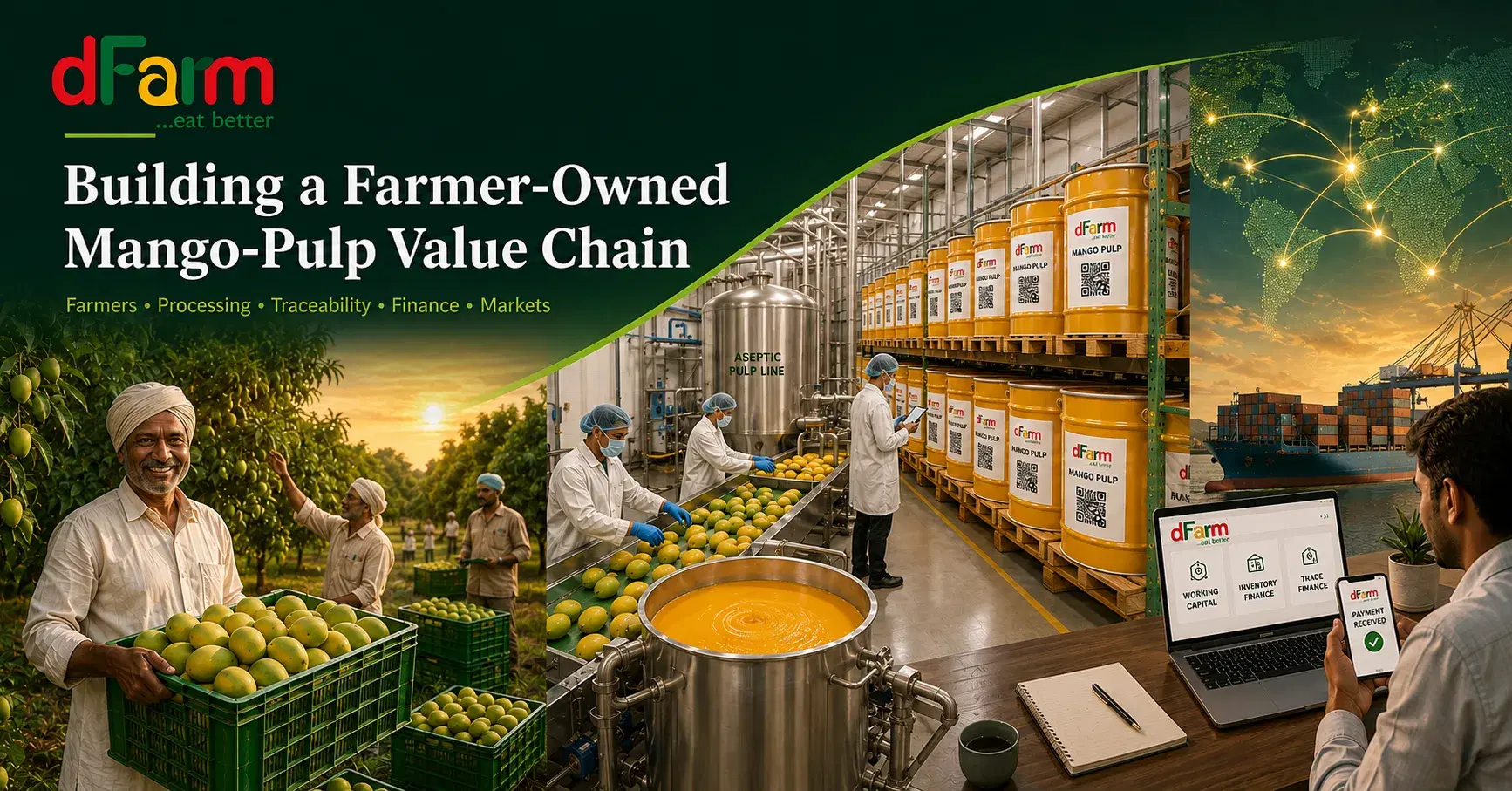
Register and plan: Onboard farmers and orchards, estimate crop volumes, record authorizations, and coordinate harvest schedules through farmer organizations and AIMS™ to reduce fruit losses.
Process under control: Procure mature fruit, record each lot, and convert the mangoes into aseptic pulp under agreed specifications and quality controls. This structured approach has improved pulp recovery by approximately 10%.
Store and verify: Place eligible barrels under professional custody with laboratory certification, insurance coverage, joint stock verification, QR-code traceability, and digital inventory records.
Finance inventory: Facilitate warehouse-receipt financing against eligible inventory, subject to lender appraisal, approved documentation, and applicable liens, thereby improving liquidity for farmers and processors.
Sell and settle: Market stock through organized buyers, record dispatch and complete transparent digital distribution after approved costs and obligations.
3. Progress Achieved in 2026
Farmer-organization alignment
On 16 April 2026, Vennar Digital Farm Pvt. Ltd. and the Consortium of Chittoor Mango Farmers Processors Cluster (CCMFPC) established a collaboration covering farmer and orchard onboarding, procurement scheduling, traceability, price discovery and exploration of financing and buyer-credit mechanisms.
June 2026: The South India Mango Farmers Federation approved the adoption of dFarm’s technology-enabled business model and value-chain support services for developing an integrated mango value chain across the Tri-State cluster.
Institutional engagement
dFarm coordinated with Warehouse Development and Regulatory Authority (WDRA) New Delhi, Andhra Pradesh Horticulture Department, Central Warehousing Corporation (CWC), the Andhra Pradesh warehousing ecosystem, Indian Bank, farmer representatives, processors, laboratories, insurers and prospective market participants.
Regulatory recognition
dFarm coordinated with both State and Central Government regulatory authorities and played a crucial role in securing recognition and notification of mango pulp as a commodity within the warehouse-financing framework. This regulatory progress creates the foundation for eligible mango-pulp inventory to support warehouse-receipt finance, subject to detailed specifications and lender approval.
Facility validation
The team visited multiple mango pulp processing units to evaluate processing, inventory, storage and operating requirements.
Operating framework
A tripartite dFarm–CWC–processor agreement was drafted to allocate roles for custody, quality, inventory, insurance, authorization, financing coordination and stock liquidation.
Bankable commercial model
The team prepared value, recovery, financing and settlement scenarios for discussion with banks, including a proposed financing reference of up to 75% against an illustrative ₹35,000/MT floor value.
Digital integration design
dFarm defined AIMS™ workflows for farmer consent, batch/lot traceability, quality records, warehouse inventory, API-based warehouse-receipt integration, lien visibility, dispatch authorization and settlement.
Risk response
In response to CWC questions, dFarm developed a time-bound inventory-monitoring and exit framework for unsold, ageing or quality-deteriorated pulp, including testing, alerts, discounted sale, alternative placement, reprocessing or lawful disposal by the responsible owner/processor.
Government price support
The value-chain model also recognizes Government intervention through PDPS (Price Deficiency Payment Scheme) providing support of up to ₹4.00/kg of mango to protect farmers during severe market-price declines. dFarm’s recommendation is to combine such temporary support with a sustainable pulp-pricing structure rather than depend on subsidy alone.
4. Proposed Commercial Model
| Model element | Current planning basis |
|---|---|
| Farmer economic interest | Farmers retain the economic interest in pulp created from their supplied fruit, subject to documented consent, charges, pledges and liens. |
| Indicative recovery | Approximately 58% pulp recovery for planning; actual recovery depends on fruit maturity, variety and processing performance. |
| Processing reference | A fixed processing-cost reference of ₹17.50/kg has been discussed and remains subject to validation and agreement. |
| Inventory value | Illustrative range of ₹35,000–₹50,000/MT; ₹42,500/MT used as an average scenario, not a guaranteed selling price. |
| Financing reference | Up to 75% of an eligible ₹35,000/MT declared value, or ₹26,250/MT, subject to bank appraisal and approved security in 2026. |
| Fees discussed | AIMS™/insurance 3.28%, sales and marketing 5%, and farmer-organization/cluster coordination 6%, subject to final commercial documentation. |
| Storage horizon | Commercial planning assumes approximately 9–10 months of storage within an expected 18–24 month shelf-life range, subject to product, packaging, testing and storage conditions. |
All figures are planning assumptions for stakeholder review and do not constitute a purchase commitment, guaranteed price, guaranteed financing or guaranteed sale.
5. dFarm Recommended Industry-Survival Price
dFarm recommends that mango-pulp pricing be based on the full cost of sustainable production, farmer protection and value-chain support. Using a mango requirement of approximately 1.75 kg for every kilogram of pulp and a farmer mango price of ₹17.50/kg as per MIS (Market Intervention Scheme), the recommended ex-factory price is calculated as follows:
| # | Cost component | Calculation / coverage | Cost per kg pulp |
|---|---|---|---|
| 1 | Farmer mango cost | ₹17.50/kg mango × 1.75 kg | ₹30.63 |
| 2 | Pulp making and consumables | Processing, utilities, packaging and consumables | ₹17.50 |
| 3 | Technology, sales and value-chain support | 20% of ₹48.13; includes technology, sales, farmer-practice education and other support | ₹9.63 |
| Recommended ex-factory mango-pulp price | ₹57.76/kg | ||
Pricing recommendation
The minimum ex-factory selling price of mango pulp should be ₹57.76 per kilogram to ensure fair returns for farmers, cover processing and value-chain costs, support market development, and maintain the industry’s financial sustainability. This benchmark should be reviewed periodically and adjusted in line with inflation.
Government support of up to ₹4.00/kg from PDPS (Price Deficiency Payment Scheme) funds can provide immediate relief to farmers when market prices collapse. However, it should complement — not replace — a transparent cost-based price that allows processors to operate sustainably and farmers to receive a viable return.
6. Governance and Risk Controls
Ownership and authorization: Farmer consent, documented ownership, disclosed liens and controlled authorization for storage, pledge, dispatch and sale.
Quality assurance: Mature-fruit procurement, lot identification, accredited laboratory testing, manufacturing accountability, packaging integrity and periodic quality review.
Custody and inventory: Joint stock verification, CWC records, AIMS™ inventory reconciliation, audit rights and API integration where available.
Finance and settlement: Lender-approved security, escrow or controlled accounts, dual authorization, transparent deductions and digital settlement records.
Shelf-life and exit: Advance alerts, market acceleration, discounting, alternative placement, reprocessing or compliant disposal before inventory becomes a liability.
Liability allocation: Manufacturing, storage, insurance and disposal responsibilities allocated to the party controlling the relevant risk, subject to final agreement terms.
7. Emerging Value and Expected Impact
Although the pilot has not yet generated final commercial results, the work completed to date has created important enabling value:
- A common operating model that aligns farmer organizations, processors, warehouses, financiers and buyers, with AIMS™ connecting all stakeholders horizontally.
- A pathway for farmers to participate in the value of processed pulp instead of depending only on peak-season fruit prices.
- Improved traceability and visibility from orchard and procurement, harvest schedules and lot identity through processing, storage, finance, dispatch and settlement.
- A strategy to energize cluster sales, reduce avoidable waste and increase utilization of existing MSME infrastructure.
- A scalable institutional template that can be replicated across the South India mango belt after a controlled pilot.
By enabling eligible pulp to be stored and financed instead of forcing immediate liquidation, the model can accelerate farmer payments, reduce the processors’ need to carry the entire inventory burden, improve cash-flow stability and support more consistent procurement and production. Regulatory recognition of mango pulp as a warehouse-finance commodity is therefore a critical step toward financial stabilization of both farmers and processing companies.
8. Roadmap to Commercial Implementation
| # | Workstream | Next milestone |
|---|---|---|
| 1 | Finalize legal framework | Close CWC, processor and dFarm operating terms; confirm ownership, custody, rent, insurance, liability, liens and liquidation authority. |
| 2 | Confirm warehouse-receipt route | Align the eNWR/warehouse-receipt structure with applicable WDRA specifications, CWC systems and lender requirements. |
| 3 | Complete lender appraisal | Validate stock valuation, margins, financing tenor, security, controlled accounts and disbursement/settlement workflow. |
| 4 | Onboard pilot participants | Select processors, farmer organizations, eligible farmers, laboratories, insurers, warehouses and buyers. |
| 5 | Configure and test AIMS™ | Complete master data, consent, traceability, quality, inventory, API, authorization and settlement workflows. |
| 6 | Execute the 2026 pilot | Target approximately 3,000 MT in one warehouse, subject to approvals, crop availability, quality and finance. |
| 7 | Review and scale | Measure recovery, price realization, storage cost, financing cycle, quality, sales velocity and farmer settlement before expanding above 30,000 MT with 4–5 processors. |
Conclusion
The mango-pulp initiative demonstrates how dFarm can use AIMS™ and value-chain coordination to convert fragmented infrastructure into an integrated market solution. Progress in 2026 has established the partnerships, operating logic, digital controls, finance discussions and risk framework required for a controlled commercial pilot. The next proof point is execution: storing eligible pulp, securing compliant finance, completing market-led sales and transparently settling farmers.
Case-study takeaway
The project’s innovation lies not in building new processing facilities, but in digitally integrating existing farmers, processors, warehouses, financial institutions, and markets into a transparent, traceable, efficient, and service-driven mango value chain.
Basis and Limitations
This case study is based on dFarm project records and stakeholder work completed through August 2026, including the February 2026 collaboration framework, institutional meetings, site visits, commercial models and the draft tripartite agreement. Figures are indicative unless expressly described as completed results. The document should be updated after execution of final agreements and completion of the pilot.